Tenor Saxophone and Bass Clarinet: A Comparison of Two Single-Reed Instruments
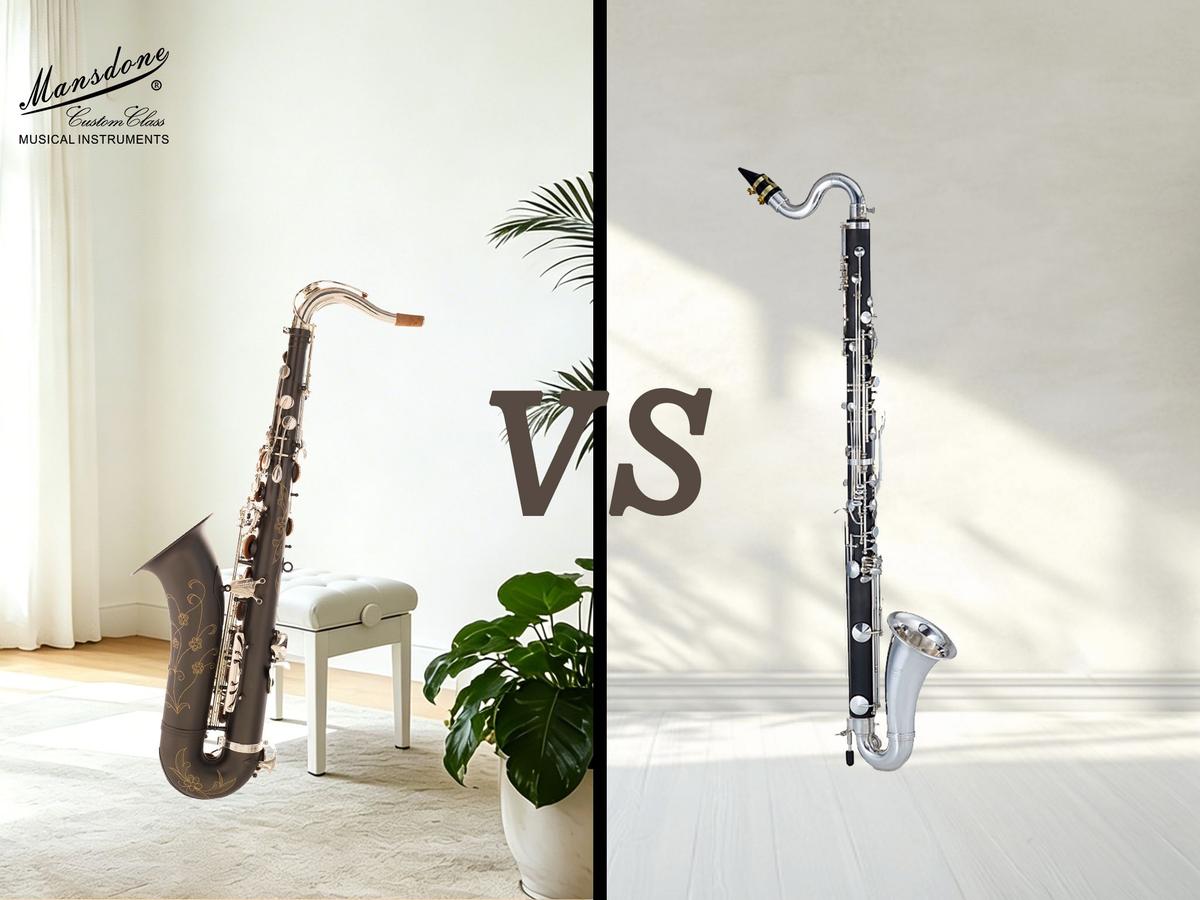
Though the B♭ tenor saxophone and the B♭ bass clarinet share a few surface-level similarities, they are fundamentally different instruments in terms of construction, range, tone, and musical role. Both are single-reed woodwind instruments, and both transpose with the same written pitch—sounding a major ninth lower than notated. However, these commonalities often lead to misconceptions about their interchangeability, which experienced musicians and composers generally advise against.
One of the most obvious differences lies in their physical build. The tenor saxophone is made of brass or other metals and features a conical bore, flaring into a curved, detachable neck and a wide bell. In contrast, the bass clarinet typically has a cylindrical, tubular shape and is constructed from ebony or plastic, with a straight body and a distinct upturned metal bell. While the tenor sax is suspended from a neckstrap, the bass clarinet rests on the floor using an endpin.
Range and register also set the two apart. The bass clarinet has a much lower range, comparable to that of the baritone saxophone, extending down to a written E♭ (sounding D♭). The tenor saxophone, by contrast, descends only to a written B♭ (sounding A♭). The optimum playing range of the tenor sax is roughly an octave higher than that of the bass clarinet. Although the bass clarinet can reach higher notes, its most effective and characteristic register remains the lower one. Both instruments share the same concert lowest note—D♭—but their overall timbral strengths differ significantly.
Tonally, the tenor saxophone is known for its varied and expressive quality, capable of bright, cutting, or mellow sounds depending on the player and context. The bass clarinet, on the other hand, is predominantly dark, rich, and somber in tone. This contrast in color influences their typical roles in ensembles. The tenor sax frequently carries melody or counterharmony, especially in jazz, where it is a staple. The bass clarinet is rarer in jazz and more often assigned to bass lines or harmonic support, functioning similarly to a baritone sax or bassoon.
In concert bands, both instruments appear regularly, and both can substitute for a bassoon part in an orchestra if necessary. Nevertheless, the bass clarinet is more closely related in function to the baritone saxophone than to the tenor. Their key systems also differ: the tenor sax follows the same key configuration as the alto sax, while the bass clarinet uses the same mechanism as the soprano clarinet.
Given these distinctions, it is generally considered poor practice to write a tenor sax part and simply label it “or Bass Clarinet” to save time or expense. Doing so overlooks the instruments’ unique ranges, tonal qualities, and idiomatic strengths, ultimately compromising the integrity of the musical arrangement.
This article is provided by Mansdone Brand Marketing Department!